
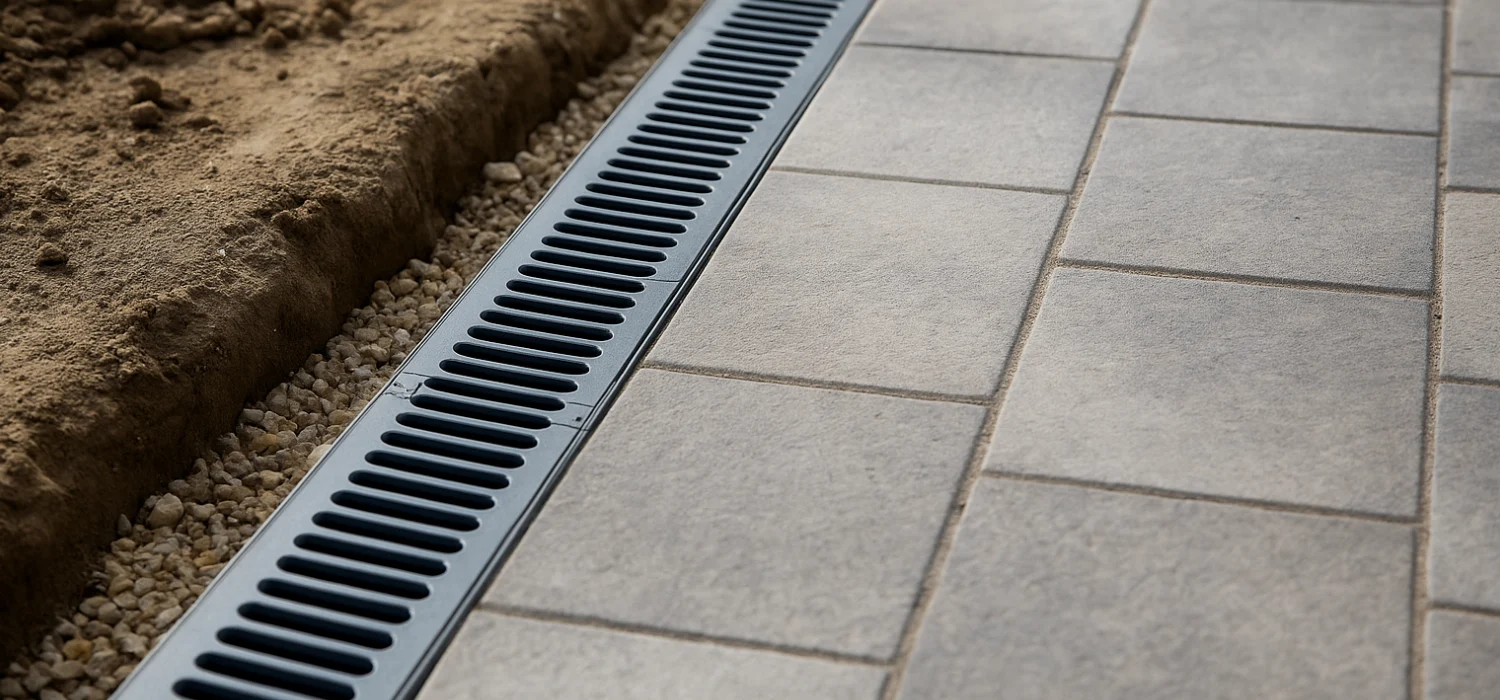
An ACO drain is a grated channel that catches surface water from a driveway, patio, threshold, car park or yard and carries it to a suitable outlet. Depending on the site, that outlet may be a surface-water drain, a correctly designed soakaway, a rain garden or another approved arrangement. Correct levels, capacity, support and an effective outfall determine whether it works.
What is an ACO drain?
An ACO drain is a channel drainage system used to collect surface water from a long, narrow strip of ground. The channel sits level with a driveway, patio, path, threshold, car park or service yard. Water enters through the grating and is carried to a suitable outlet instead of pooling on the surface.
ACO is a drainage manufacturer and brand name. In everyday UK use, “ACO drain” is often used more broadly to describe channel drains, linear drains and trench drainage. The right product is not chosen by the name alone: the expected water flow, traffic loading, channel size, grating and final outfall all matter.
How does an ACO drain work, and where does the water go?
A typical system contains interlocking drainage channels, removable gratings, an outlet or sump unit and a connection to the wider surface-water system. The surrounding paving is laid to fall towards the channel. When it rains, runoff reaches the grating, enters the channel and flows towards the outlet.
The outlet must lead somewhere suitable. Depending on the property and ground conditions, that may be a surface-water drain, a correctly designed soakaway, a rain garden or another approved surface-water arrangement. A channel with no effective outfall will simply hold water and silt.
Where are ACO drains used?
- Driveways and garage thresholds: to intercept runoff before it reaches a garage or building entrance.
- Patios and paved gardens: to reduce standing water where levels or impermeable finishes concentrate rainfall.
- Paths and accessible entrances: to manage water across doorways and frequently used routes.
- Car parks and commercial yards: to collect runoff across larger trafficked areas.
- Loading bays and industrial sites: where the channel and grating must be selected for heavier or repeated vehicle loads.
For car parks, yards and loading areas, arrange a commercial drainage assessment to check runoff, outfall capacity and traffic loading before specifying the system.
Choosing the correct channel and load rating
A patio, domestic driveway and commercial loading area place very different demands on a drainage channel. The complete installation—including the channel, grating, bedding and surrounding construction—must be suitable for the heaviest traffic likely to cross it.
Selection should also account for the catchment area, rainfall runoff, channel capacity, outlet position, available depth, gradients and the amount of silt or debris expected. A lightweight channel in a vehicle route can crack or move; an undersized outlet can cause water to back up even when the channel itself looks clear.
Does an ACO drain need a soakaway?
Not always. A channel drain collects and transports water; a soakaway disperses water into suitable ground. The correct destination depends on the site, soil, existing drainage, nearby foundations and local restrictions. A soakaway is not appropriate everywhere, particularly where ground does not infiltrate effectively or there is insufficient separation from buildings and other constraints.
For front gardens in England, planning rules encourage permeable surfacing or arrangements that direct runoff to a permeable area. Proposals involving larger impermeable areas should be checked against current planning guidance and local requirements before work starts.
Can an ACO drain stop driveway flooding?
It can help when the flooding is caused by surface water running across the driveway and the system is correctly positioned, sized and connected. It will not solve every flooding problem. High groundwater, collapsed pipes, overloaded public drainage, water arriving from neighbouring land or an inadequate outfall may require a broader investigation.
Where the source is uncertain, a drainage survey can establish levels, routes and defects before new channels are installed. AFS can combine surface-water assessment with CCTV drain surveys and drain repairs where the existing system may be contributing to the problem.
How professional channel-drain installation is planned
- Survey the water route: identify where runoff starts, the low points and the area feeding the proposed channel.
- Confirm the outfall: establish where collected water can lawfully and reliably discharge.
- Check levels and services: confirm the available fall, finished surface levels and the position of buried utilities.
- Select the system: match channel capacity, grating, load rating and material to the site.
- Install and restrain the channel: provide the specified bedding and surrounding support so the system remains aligned under use.
- Connect and test: confirm that water reaches the channel, travels to the outlet and clears without backing up.
Common ACO-drain problems
- Leaves, silt or construction debris restricting the channel or outlet.
- Paving that falls away from the channel instead of towards it.
- A blocked, undersized or disconnected outlet.
- Channels or gratings that are not rated for the traffic crossing them.
- Movement or cracking caused by inadequate support around the channel.
- Water being collected faster than the downstream system can accept it.
How to clean and maintain an ACO drain
Remove loose debris from the grating, lift removable sections where safe, clear silt from the channel and inspect the outlet or sump. Maintenance frequency depends on nearby trees, traffic, the surface material and how much sediment washes into the system. Repeated backing-up, movement, broken gratings or water returning from the outlet needs investigation rather than repeated surface cleaning.
ACO drain installation by Alton Facility Services
AFS surveys, specifies and installs channel drainage for homes, managed properties and commercial sites across Hampshire, Surrey, West Sussex and nearby areas. We can assess the runoff route, existing drainage and intended traffic before recommending a suitable system.
For help with a driveway channel, commercial linear drainage or recurring surface-water problem, send AFS the site details and postcode or call 01420 561661.
ACO drain questions
What is the difference between an ACO drain and a channel drain?
ACO is a drainage brand. Channel drain and linear drain are generic names for the type of long, narrow surface-water system. People often use “ACO drain” to describe the whole product category.
Where should a driveway channel drain be positioned?
It is commonly placed across a runoff path, such as in front of a garage or entrance. The correct position depends on site levels, water direction and the available outlet, so those points should be surveyed first.
Can an ACO drain connect to a soakaway?
It can where infiltration, available space, separation from structures and local requirements make a soakaway suitable. Ground conditions and the proposed discharge route should be checked before installation.
Why is water sitting in my channel drain?
Common causes include silt, a blocked outlet, insufficient fall, a damaged connection or a downstream system that cannot accept the flow. Clearing the grating alone may not resolve an outlet or level problem.
Speak to Alton Facility Services for practical drainage, pump or wastewater advice.
Contact AFS